
Choosing between an oil-lubricated and an oil-free air compressor is not simply a choice between “economical” and “clean.” The right decision depends on what the compressed air touches, the purity level your process requires, your operating profile, and the cost of downtime or contamination.
For many general manufacturing plants, an oil-lubricated rotary screw compressor is a practical and efficient choice. For processes where even a small amount of oil can affect product safety, product quality, or compliance, an oil-free compressor may be the safer starting point.
The Short Answer
Neither type is automatically better.
Choose an oil-lubricated compressor when you need reliable industrial air for general production, pneumatic tools, metalworking, assembly, packaging equipment, or other applications where the air does not directly affect a sensitive product—and where correctly selected downstream treatment is acceptable.
Choose an oil-free compressor when compressed air may contact food, medicine, electronics, medical products, optical components, or other contamination-sensitive materials. It is also a strong option when your risk assessment or customer specification requires an oil-free compression process.
The important point is this: compressor technology and delivered air quality are related, but they are not the same thing.
What Is an Oil-Lubricated Air Compressor?
In an oil-lubricated, or oil-injected, rotary screw compressor, lubricant is introduced into the compression chamber. The oil performs several important jobs:
- It lubricates moving parts.
- It helps seal the small clearances between the rotors.
- It absorbs compression heat.
- It carries heat away from the air end for cooling and separation.
After compression, the air-and-oil mixture enters an air/oil separator. The separated lubricant is returned to the compressor, while the compressed air continues through the system. Depending on the air-quality target, the system may also include a water separator, refrigerated or desiccant dryer, coalescing filters, activated-carbon filtration, and point-of-use filters.
This technology is widely used because it can deliver stable compressed air efficiently for a broad range of industrial duties.
What Is an Oil-Free Air Compressor?
An oil-free compressor is designed so that oil is not introduced into the compression chamber. Depending on the technology, it may use precision rotor clearances, water lubrication, special coatings, self-lubricating materials, or a different compression mechanism such as scroll or centrifugal compression.
However, “oil-free compressor” should not be interpreted as “no air treatment required.”
Atmospheric intake air can already contain hydrocarbons, oil vapour, dust, and moisture. The air distribution network can also introduce particles, condensate, or other contaminants. If your process requires a specified purity class at the point of use, the complete compressed-air system—not just the compressor—must be designed, maintained, and verified accordingly.
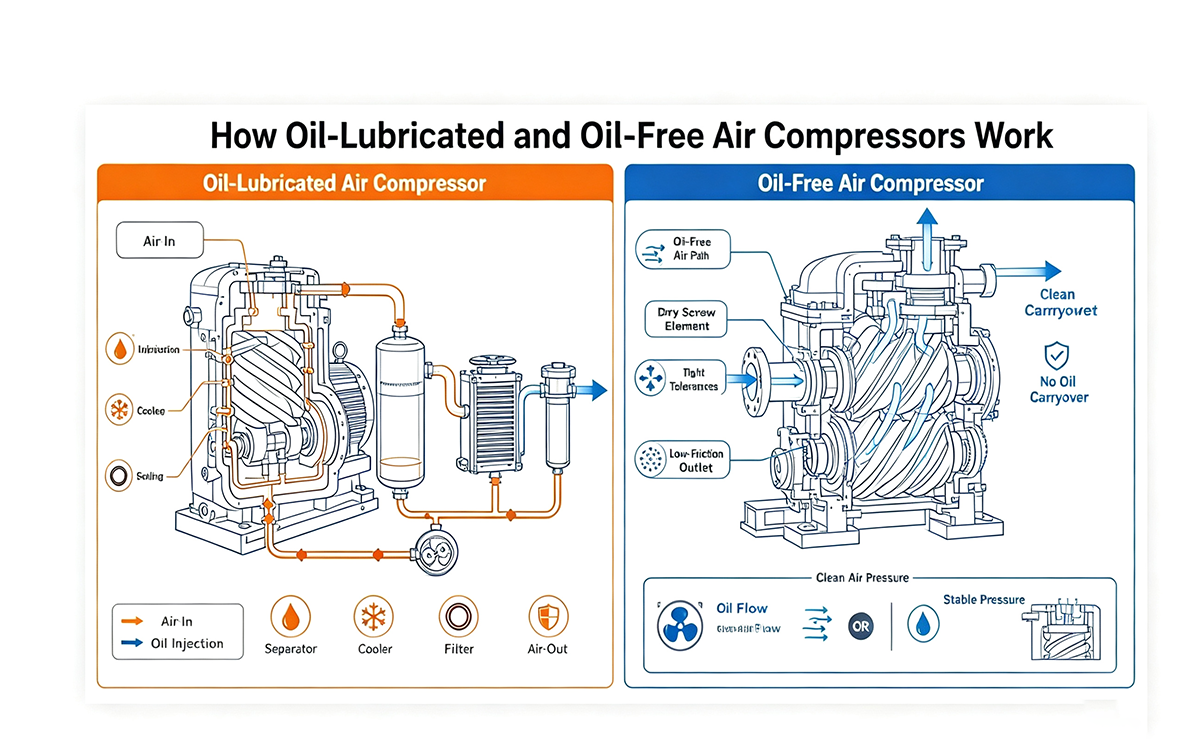
The Technical Difference: What Happens Inside the Compression Stage?
| Topic | Oil-Lubricated Compressor | Oil-Free Compressor |
|---|---|---|
| Lubrication in compression chamber | Oil is injected for sealing, cooling, and lubrication. | No oil is introduced into the compression chamber. |
| Compression temperature control | Oil absorbs heat during compression. | Heat is managed through compression design, cooling stages, water lubrication, coatings, or other methods. |
| Air-end design | Oil-tolerant rotor design with air/oil separation downstream. | Requires technology that avoids oil in the air path during compression. |
| Downstream treatment | Usually essential to control remaining oil aerosols, vapour, water, and particles. | Still required when a defined point-of-use air-quality class is needed. |
| Main purchasing priority | Reliable general industrial air at a balanced investment cost. | Lower process-contamination risk in air-sensitive applications. |
For an oil-injected screw compressor, the separator is a key component, but it is not the final air-quality guarantee. A buyer should ask for the expected oil carryover, separator maintenance requirements, recommended filtration train, pressure drop across filters, and the test point used for any air-quality claim.
For an oil-free compressor, buyers should ask what “oil-free” specifically means for that model: dry compression, water-lubricated compression, scroll, centrifugal, or another technology. They should also request the applicable ISO 8573-1 air-quality specification and supporting documentation where required.
Air Quality: Do Not Compare Compressors Without Comparing the Required ISO Class
ISO 8573-1 classifies compressed-air purity by particles, water, and oil. The three values in a specification each matter. For example, a requirement may define a particle class, a pressure-dew-point class, and an oil class.
Oil must be considered in three forms:
- Liquid oil
- Oil aerosols
- Oil vapour
This is why a buyer should not approve a system based only on a statement such as “low oil carryover” or “Class 0 air” without asking where and how the air will be measured.
An oil-free compressor reduces the risk of compressor-generated oil entering the air stream. But if you require a particular purity level at the point of use, intake conditions, dryers, filters, piping, drains, receiver tanks, maintenance practices, and monitoring all remain relevant.
Conversely, an oil-lubricated compressor with properly engineered downstream purification can achieve a very high air-quality level. But this approach adds components that must be correctly sized, installed, monitored, and serviced. A missed filter replacement or an overloaded filter can become a process risk.
Advantages of Oil-Lubricated Air Compressors
1. Strong fit for general industrial production
Oil-lubricated rotary screw compressors are commonly selected for machine shops, fabrication plants, general assembly, tire service, non-food pneumatic conveying, industrial tools, and many factory utility-air systems.
If air is used to power cylinders, valves, tools, or machines and does not contact a sensitive product, this technology can offer a sensible balance between performance and initial investment.
2. Efficient compression for continuous-duty applications
Oil injection helps cool and seal the compression process. In suitable operating conditions, this supports stable performance for continuous industrial use. The actual energy result still depends on compressor sizing, pressure setting, leakage, load profile, control method, and system pressure drop.
Do not assume that either oil-lubricated or oil-free technology is always more energy efficient. Compare the specific package performance at your required working pressure and flow range.
3. Broad availability and familiar service requirements
Oil-lubricated screw compressors, parts, lubricants, separators, and service knowledge are widely available in many markets. For distributors and end users with established maintenance teams, this can simplify spare-parts planning and service training.
4. Lower initial equipment cost in many projects
For many general-purpose applications, an oil-lubricated solution has a lower initial equipment cost than an equivalent oil-free system. But purchase price alone is not the correct comparison. Include filters, dryers, replacement elements, energy consumption, planned maintenance, and the potential cost of poor air quality.
Limitations of Oil-Lubricated Air Compressors
The main limitation is not that the technology is unsuitable; it is that the system carries an oil-contamination risk that must be managed.
You should be cautious when:
- Compressed air directly contacts food, beverages, pharmaceuticals, or medical products.
- A downstream process is sensitive to hydrocarbon vapour or oil aerosols.
- Your customer, auditor, or internal quality system requires an oil-free compression process.
- A filter failure could cause costly product rejection, cleanup, or reputational damage.
- You cannot maintain the required filtration and monitoring program consistently.
Oil-lubricated systems also require routine management of lubricant condition, separator elements, oil filters, condensate, and leakage. These are normal maintenance responsibilities, not reasons to reject the technology—but they must be included in the operating plan.
Advantages of Oil-Free Air Compressors
1. Lower compressor-side contamination risk
Because oil is not introduced into the compression chamber, oil-free technology reduces the chance that compressor lubricant enters the compressed-air stream. This is especially valuable when a contamination event could affect the finished product or interrupt a critical process.
2. Suitable for air-sensitive industries
Oil-free systems are often considered for the following applications:
- Food and beverage processing and packaging
- Pharmaceutical and biotechnology production
- Medical and dental air applications
- Electronics and semiconductor-related processes
- Textile manufacturing where staining or fibre contamination is a concern
- Optical, laboratory, and precision-instrument processes
- PET bottle blowing and selected clean manufacturing applications
- Paint, coating, and surface-treatment processes where air quality is critical
The final selection should be based on the actual point-of-use requirement, not only the industry name. A food plant, for example, may have both critical direct-contact applications and non-critical utility-air applications. The entire plant does not always need one identical air-treatment design.
3. Better alignment with risk-control requirements
For a company selling into regulated or highly quality-sensitive supply chains, an oil-free compressor can make it easier to demonstrate a conservative contamination-control approach. This may be important when a customer’s specification explicitly requests oil-free compression or a certified air-quality class.
4. Reduced dependence on oil-removal treatment for compressor-generated oil
Oil-free compression does not eliminate the need for moisture, particle, or intake-vapour control. It can, however, reduce dependence on downstream equipment whose primary purpose is removing lubricant introduced by the compressor itself.
Limitations of Oil-Free Air Compressors
Oil-free technology should be selected for process value, not simply for marketing language.
Potential considerations include:
- Higher initial equipment investment for some technologies and capacities
- Different maintenance procedures and spare-parts requirements
- Sensitivity to operating conditions, cooling-water quality, ambient temperature, or installation quality depending on the technology
- Continued need for dryers and filters when a complete air-quality specification must be achieved
- The need to validate certification claims for the exact compressor model and configuration
A buyer should also distinguish between an oil-free machine and a certified delivered-air system. The first describes the compression technology; the second depends on the whole system and the defined measurement point.
Which Industries Usually Fit Each Option?
| Application | Typical Starting Option | Why |
|---|---|---|
| General manufacturing and assembly | Oil-lubricated | Utility air usually prioritizes reliability and cost balance. |
| Pneumatic tools and workshop equipment | Oil-lubricated | Often suitable when the air does not contact a sensitive product. |
| Metal fabrication and machining | Oil-lubricated | Common for general plant air; confirm requirements for painting or precision processes. |
| Automotive assembly | Depends on process | General assembly may use oil-lubricated air; painting and sensitive automation may need higher purity. |
| Food and beverage | Oil-free or engineered high-purity system | Product-contact risk and customer requirements are decisive. |
| Pharmaceuticals and biotechnology | Oil-free or engineered high-purity system | Product safety, validation, and contamination control are central. |
| Electronics and precision manufacturing | Oil-free or high-purity system | Oil vapour, particles, and moisture can affect yield and quality. |
| Textile production | Depends on process | Oil-free is valuable where fibre contamination or staining is a concern. |
| PET bottle blowing | Often oil-free | Air quality can directly influence the production process and finished packaging. |
“Typical” does not replace an engineering review. Your application, required purity class, and local regulations should decide the final configuration.
A Practical Buying Checklist
Before requesting quotations, answer these questions:
- What does the compressed air touch: a product, packaging, a tool, or only a pneumatic actuator?
- What air-quality class is required at the point of use?
- Does your customer specification require an oil-free compressor, or only a defined delivered-air quality?
- What flow and pressure are required during average, peak, and future production?
- Will demand be stable, variable, or shift-based?
- What are the ambient temperature, humidity, dust level, and available utilities?
- What dryer, filters, receiver tank, drains, and monitoring are included in the quotation?
- What maintenance tasks and consumables are required, and at what intervals?
- What is the cost if a contamination event stops production or causes product rejection?
- Can the supplier provide system drawings, air-quality recommendations, and documentation for the proposed configuration?
Oil-Lubricated vs. Oil-Free: Make the Decision Based on Risk and Total Cost
If your application needs dependable general industrial air, an oil-lubricated screw compressor with the right treatment system is often a strong solution. If oil contamination could compromise product quality, safety, customer approval, or regulatory compliance, oil-free compression is often the more appropriate starting point.
The best choice is the one that delivers the required air quality at the point of use, with a realistic maintenance plan and an acceptable total cost of ownership.
Before you compare compressor quotations, define your required flow, pressure, duty cycle, application, and air-quality target. A properly selected compressor package should include the compressor, dryer, filters, receiver tank, condensate management, and controls needed for your real operating conditions.
FAQ
Is an oil-free air compressor always better than an oil-lubricated compressor?
No. Oil-free compressors are better for applications where compressor-side oil contamination creates an unacceptable risk. Oil-lubricated compressors can be a more cost-effective and reliable choice for many general industrial air applications.
Can an oil-lubricated compressor supply high-purity air?
Yes, with correctly selected and maintained downstream purification equipment. The required purity should be specified at the point of use, including particle, water, and total-oil requirements.
Does an oil-free compressor eliminate the need for filters and a dryer?
No. Air from the atmosphere can contain dust, moisture, and oil vapour. Filters and dryers may still be required to meet the specified air quality and pressure dew point.
What does ISO 8573-1 Class 0 mean?
Class 0 is the most stringent oil-purity classification under ISO 8573-1, with performance defined by the compressor manufacturer and more demanding than Class 1. Ask the supplier for the exact certification scope, test method, and model-specific documentation.
Which compressor is better for food and beverage production?
Start with the process risk. Where compressed air contacts product or primary packaging, oil-free compression or a properly engineered high-purity system is commonly considered. Confirm the air-quality target with your food-safety and quality teams.
Are oil-free compressors maintenance-free?
No. They still need planned maintenance. Service requirements depend on the technology and may include filters, cooling components, seals, valves, bearings, dryer maintenance, and air-quality-system checks.
Is an oil-lubricated screw compressor less energy efficient?
Not necessarily. Energy performance depends on the specific compressor, operating pressure, flow profile, control method, leakage level, and pressure drop across the whole treatment system. Compare package data under your actual duty conditions.
What information should I provide when asking a supplier for a quotation?
Provide required flow, working pressure, operating hours, application, air-quality target, ambient conditions, voltage, whether demand varies, and any special requirements for dryer, tank, filters, remote monitoring, or certification.