Industrial Air Compressor Applications: 7 Common Uses in Manufacturing
Compressed air is often called the “fourth utility” in industrial settings—alongside electricity, water, and natural gas. For plant managers and maintenance engineers, understanding where and how industrial air compressors deliver value is the first step toward optimizing operations and making informed equipment investments.
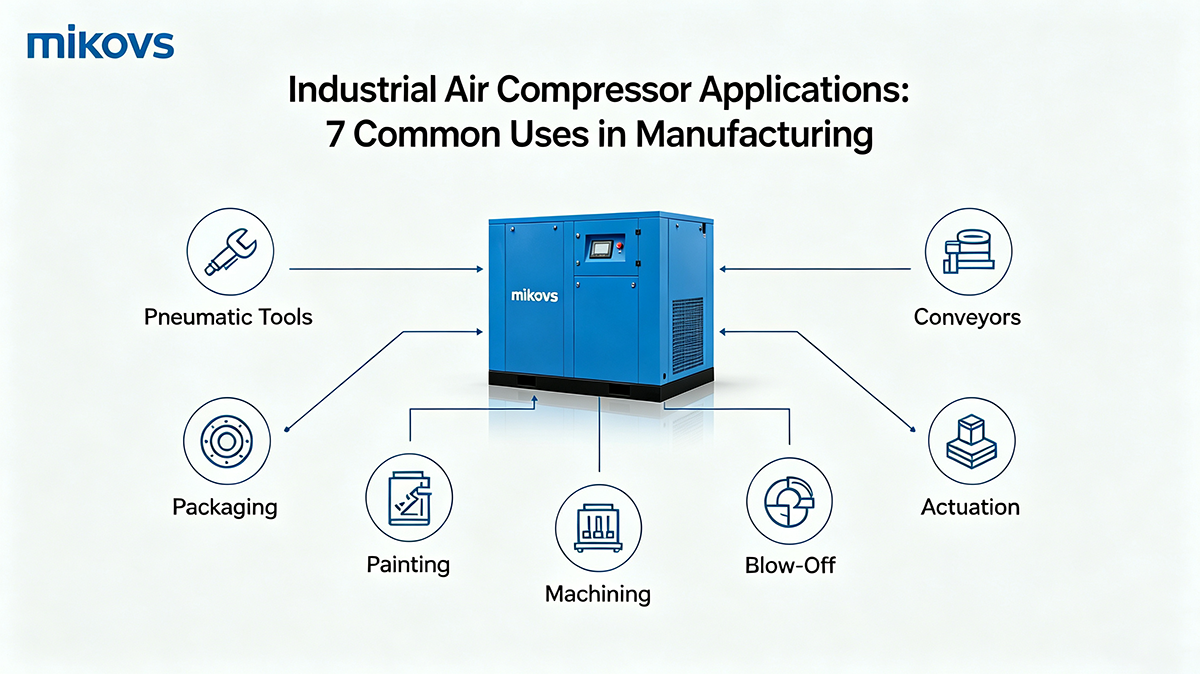
Below are seven of the most common industrial air compressor applications across manufacturing and production environments.
1. Powering Pneumatic Tools
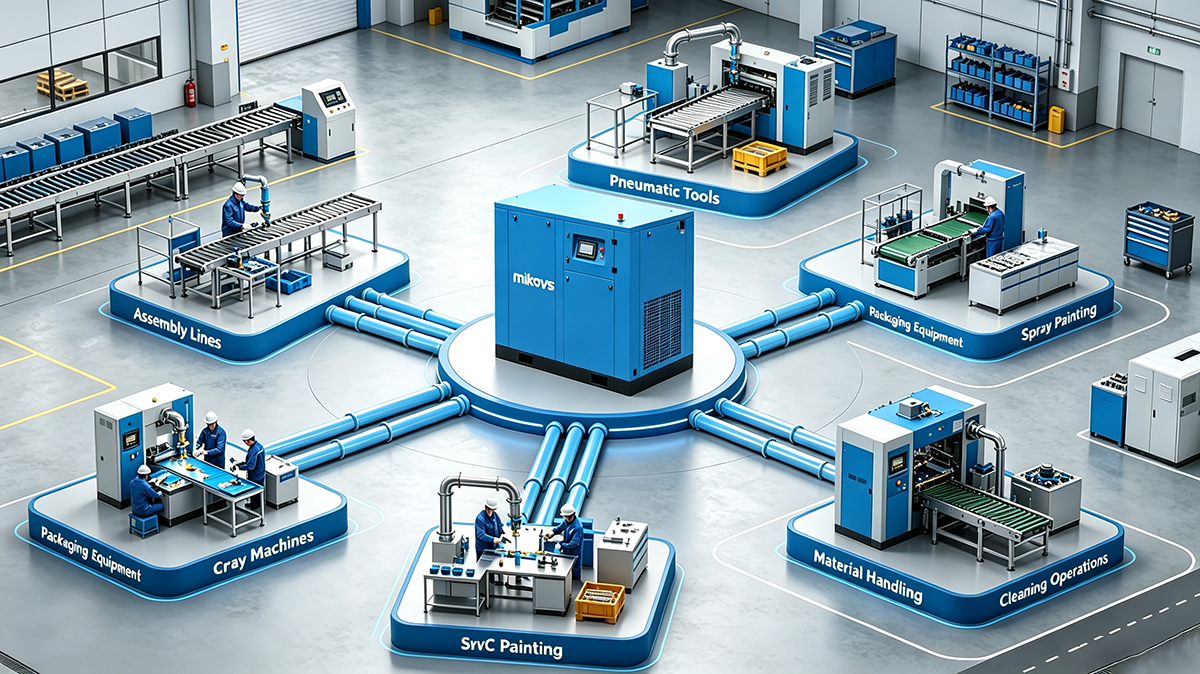
The most direct and widespread use of industrial air compressors is supplying power to pneumatic tools. On assembly lines and construction sites alike, compressed air drives impact wrenches, drills, grinders, nail guns, and spray guns. These tools rely on consistent pressure and airflow—typically measured in PSI and CFM—to perform reliably.
For manufacturing facilities, pneumatic tools offer advantages over electric alternatives: they are lighter, generate less heat, and have fewer electrical safety risks in wet or dusty environments.
2. Automation and Production Line Control
In modern factories, compressed air is the muscle behind automated systems. Pneumatic actuators, cylinders, and valves control conveyor belts, robotic arms, sorters, and clamping mechanisms. These components allow precise, repeatable movements essential for high-volume production.
Whether it’s stamping metal parts or positioning components for assembly, compressed air enables automation that would otherwise require more complex and costly electrical systems.
3. Material Handling and Packaging
Compressed air powers a wide range of material handling equipment, from air hoists and vacuum lifters to conveyor systems. In packaging operations, it drives strapping machines, palletizers, and carton sealers.
In food and beverage production, oil-free air is especially critical for direct contact applications such as bottle cleaning, filling, and packaging to prevent contamination. This requirement often drives the choice between oil-injected and oil-free compressor technologies.
4. Spray Painting and Surface Coating
Achieving a smooth, even finish in automotive, furniture, or equipment painting relies on clean, dry compressed air. Air compressors provide the atomizing pressure needed for spray guns to deliver consistent coating thickness and coverage.
In this application, air quality is a key consideration—moisture or oil particles in the airstream can ruin a finish and lead to costly rework. This is why many painting operations specify dryers and filtration systems alongside their compressors.
5. Industrial Cleaning and Blow-Off
Compressed air is commonly used for cleaning—blowing debris, dust, or coolant off machined parts, workpieces, and production equipment. It also clears chips from cutting tools and dries components after washing or plating processes.
In electronics manufacturing, clean compressed air removes particles from circuit boards and sensitive components without damaging surfaces. For these applications, air purity is as important as pressure.
6. HVAC and Refrigeration Systems
Industrial air compressors play a role in facility-wide heating, ventilation, and air conditioning systems. They power control valves, dampers, and pneumatic thermostats that regulate building climate.
In cold storage and food processing, compressed air is used in refrigeration cycles and cooling systems to maintain precise temperature control. This application often requires continuous-duty compressors capable of running reliably over extended periods.
7. Energy and Petrochemical Operations
In oil refineries, power plants, and pipeline operations, compressed air serves multiple critical functions: instrument air for valve and actuator control, pipeline drying and purging, and nitrogen generation. These applications demand high reliability—any interruption can mean safety risks or production downtime.
For offshore and remote sites, portable compressor solutions are often specified to match the rugged operating environment and limited maintenance access.
Choosing the Right Compressor for Your Application
Understanding these seven applications is only half the picture. The next step—selecting a compressor that fits your specific needs—requires careful evaluation of:
- Flow (CFM) and pressure (PSI) required by your tools and processes
- Duty cycle: intermittent vs. continuous operation
- Air quality: whether oil-free air is required for your application
- Technology type: piston vs. rotary screw vs. centrifugal
A compressor that’s undersized won’t meet production demands; one that’s oversized wastes energy and drives up lifecycle costs—up to 80% of which come from electricity consumption.
Review the applications that match your operations.
Understanding your application is the starting point. Once you know your requirements—flow, pressure, duty cycle, and air quality—you can evaluate compressor options with confidence.