
Inverter Air Compressor Energy Savings: A Practical Analysis
If you manage a manufacturing facility, you’ve likely heard the pitch: switch to an inverter air compressor and watch your electricity bills drop. The logic sounds simple—adjust motor speed to match demand, eliminate wasteful unloading, save energy. But the question many plant managers and maintenance engineers ask before committing capital is more cautious: does it really work in our specific setup?
The short answer is yes—but only under the right conditions. This article cuts through the marketing claims to explain how inverter compressors save energy, when they deliver meaningful savings, and how to calculate whether a upgrade makes financial sense for your operation.
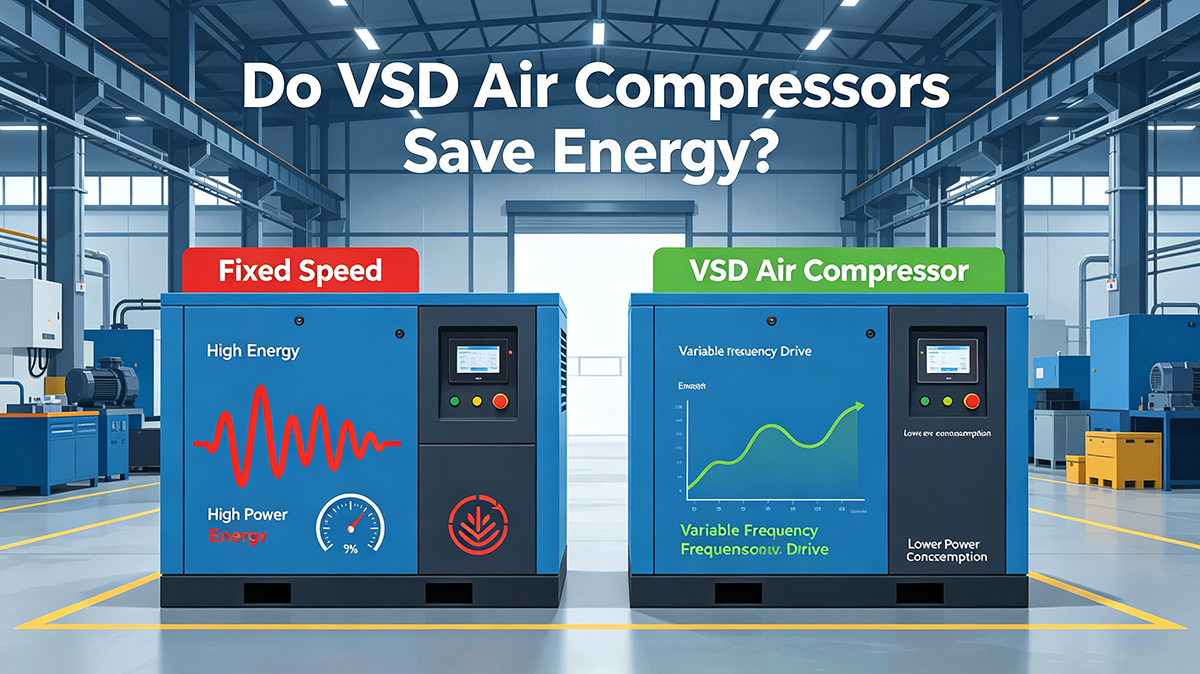
How a Traditional Fixed-Speed Compressor Wastes Energy
To understand why inverter compressors can save energy, you first need to understand where fixed-speed machines waste it.
Traditional industrial air compressors run at a constant motor speed. They control air output using a load/unload (or start/stop) method: when the air receiver tank pressure reaches the upper setpoint, the compressor unloads—the motor keeps running but stops producing compressed air; when pressure drops to the lower setpoint, it loads back up and resumes full-speed compression.
The waste happens in two places:
1. Unloading power consumption. During unloading, the motor still spins, consuming roughly 40%–50% of its rated power while producing zero useful compressed air. If your production line has frequent stops, shift changes, or variable output, the compressor might spend significant time in this unloaded state—essentially burning electricity without doing any work.
2. Pressure band inefficiency. Fixed-speed compressors operate within a pressure band—say, 0.6 to 0.8 MPa. The compressor loads at 0.6 MPa and unloads at 0.8 MPa. The higher average system pressure means the compressor must do more work than if it could maintain a steady pressure closer to the minimum requirement.
3. Oversized design. Because compressors must handle peak demand, they are typically sized for maximum load. In reality, most operations run at partial load for a significant portion of the time—a classic “big engine pulling a small cart” scenario.
How an Inverter Compressor Changes the Equation
An inverter (also called VSD—Variable Speed Drive) compressor uses a drive to adjust motor speed continuously in response to actual air demand.
Instead of running at full speed and dumping excess air, the inverter compressor slows down when demand drops and speeds up when demand rises. A pressure sensor monitors system pressure in real time—often with accuracy as tight as ±0.01 to ±0.02 MPa (approximately ±0.14–0.29 PSI). The inverter adjusts motor speed to hold pressure at a single setpoint rather than cycling between high and low.
This delivers three tangible benefits:
| Benefit | How It Works | Impact |
|---|---|---|
| Eliminates unloading waste | Motor speed drops instead of running unloaded | No 40–50% idle power consumption |
| Stable system pressure | Pressure maintained at lowest usable setpoint | Less work per unit of air delivered |
| Soft start | Ramp-up, not full-current inrush | Lower electrical stress, less mechanical wear |
For a typical industrial application with fluctuating demand, reported energy savings from switching to inverter control range from 15% to 35%, and in some cases up to 60% under optimal conditions.
The Critical Reality Check: When Savings Disappear
Here is where many equipment vendors gloss over the details. Inverter compressors do not save energy in every application.
The saving effect depends almost entirely on your load profile—how your air demand varies throughout the day, week, and year.
High-Savings Scenarios (Best Fit for Inverter)
Your operation is a strong candidate for inverter savings if:
- Load fluctuates significantly. Production lines start and stop; multiple shifts have different output levels; weekend/off-hours demand is low.
- Average load is 60%–80% of full capacity. This is the sweet spot where inverter modulation delivers maximum avoidance of unloading waste-5.
- Pressure stability matters. Processes requiring consistent pressure benefit from the ±0.02 MPa control.
- Multiple compressors in a system. Inverter units can serve as the “trim” compressor that handles fluctuations while fixed-speed units handle base load.
Industry examples cited for variable load applications include textiles, electronics assembly, food packaging, and automotive parts manufacturing-2-5-7.
Low-Savings Scenarios (Inverter Not Worth the Premium)
A inverter compressor adds 20%–40% to the purchase price over an equivalent fixed-speed unit. If your operation fits these descriptions, the payback may be too long or never materialize:
- Air demand is stable and continuous. Production runs 24/7 at near-full load with minimal variation.
- High base load with limited fluctuation. The compressor rarely unloads; most savings potential is theoretical.
- Single large machine serving a constant process. Little to no load variation to modulate against.
As industry analysis notes, if your operation has stable, near-full-load demand year-round, a fixed-speed compressor may offer better overall value when comparing purchase cost against achievable savings-7.
Real-World Evidence: What Actual Plants Have Achieved
Case data from manufacturing facilities provides a more grounded picture than theoretical modeling.
A motorcycle and automotive parts manufacturer in Vietnam replaced four aging fixed-speed compressors with inverter-equipped units. The company’s technical department reported that the previous machines—in service since 1997—had depreciated efficiency to the point where they were causing significant energy waste. After replacing them with inverter compressors and simultaneously repairing 328 compressed air leak points, the company saved approximately 48,544 kWh per year, equivalent to over 90 million Vietnamese dong in electricity costs.
While this example combines multiple energy measures (leak repair + inverter upgrade), it illustrates the real-world magnitude of achievable savings—and importantly, it shows that even mature manufacturing operations with older equipment can see measurable results.
How to Calculate ROI for Your Facility
Before approving a purchase, you need a realistic estimate of payback period. Here is a simplified calculation framework using industry-standard assumptions.
Sample calculation for a 55kW compressor:
| Parameter | Assumption |
|---|---|
| Rated power | 55 kW |
| Annual run hours | 6,000 hours |
| Industrial electricity rate | $0.12/kWh (or 0.85 RMB/kWh) |
| Load profile | Fluctuating, 65% average load |
| Estimated energy savings vs. fixed-speed | 20% |
Annual savings = 55 kW × 6,000 h × $0.12 × 20% = $7,920/year
If the inverter model costs $8,000 more than the equivalent fixed-speed machine, simple payback = approximately 12 months.
However, if your load is steady at 95%, the savings might drop to 5%–8%, extending payback to 3–5 years or more—which may not justify the premium.
Factors That Change Your Numbers
- Local electricity price: Higher rates = faster payback.
- Annual runtime: More hours = more savings to recoup.
- Leakage in your distribution system: Industry estimates suggest 20%–30% of compressed air is lost to leaks in typical plants. Fixing leaks first can reduce required capacity—and may eliminate the need for a larger compressor altogether.
- Maintenance savings vs. costs: Inverter soft start reduces mechanical shock on motors, bearings, and drive components, potentially lowering maintenance frequency. However, inverter units may require more specialized technicians for repairs.
Before You Buy: Two Practical Steps
1. Audit your actual air demand. A proper energy audit should include:
- Measuring load over a full production cycle (not just a snapshot)
- Identifying peak demand times and durations
- Quantifying how much time the compressor spends unloaded
- Mapping pressure loss across your distribution piping
Some compressor manufacturers offer on-site services to assist with this analysis.
2. Fix leaks first. Many plants can reduce total air demand by 15%–25% simply by repairing leaks. If you upgrade to an inverter without fixing leaks, you are buying a larger machine than necessary—and losing savings that could have come from the lowest-cost measure available.
Final Takeaway
Inverter air compressors are a proven technology that can deliver real, measurable energy savings—but they are not a universal solution. The technology shines when your air demand fluctuates and your average load sits in the 60%–80% range. If your operation runs steady and full, a fixed-speed compressor may be the more cost-effective choice.
The smart approach is not to ask “do inverter compressors save energy?” but rather “will an inverter compressor save energy in my specific plant?” The answer requires data—not marketing brochures.
Review your load profile before making a decision.