
An air compressor tank is a pressure vessel. It stores energy at pressures that, if released suddenly through a structural failure, can cause serious injury or death. Most tank failures do not happen without warning—they are the result of internal corrosion that progresses over years, hidden from view until the wall thickness drops below a safe threshold.
This guide covers the regulatory requirements, safety hazards, what inspectors examine, and how to decide whether a tank should be repaired, replaced, or continued in service.
Understanding Tank Inspection Requirements
ASME Code
In the United States, air receiver tanks operating above 15 psig fall under the ASME Boiler and Pressure Vessel Code, Section VIII, Division 1. A compliant tank carries an ASME “U” stamp on its nameplate, along with the maximum allowable working pressure (MAWP), manufacturer, and year of construction.
The nameplate is the primary evidence that the tank meets the applicable code—and it is the first thing an inspector or insurance auditor will check. Do not alter, obscure, or remove it.
OSHA Requirements
OSHA’s General Industry standard (29 CFR 1910.169) applies to compressed air receivers and sets minimum requirements for installation, drainage, pressure gauges, and safety relief valves.
A critical point often misunderstood: OSHA does not require periodic hydrostatic retesting of air receivers under 29 CFR 1910.169. However, this does not mean inspection is optional. The standard requires tanks to be drained frequently, equipped with accessible drains, and fitted with a visible pressure gauge and spring-loaded safety valve.
For shipyard employment, a different standard (29 CFR 1915.172) applies: portable unfired pressure vessels must be examined quarterly and hydrostatically tested yearly.
Practical takeaway: Even where periodic hydrostatic testing is not mandated, internal visual inspection and thickness measurement remain the only reliable ways to detect corrosion before it becomes dangerous.
Safety Hazards Associated With Uninspected Tanks
The Corrosion Mechanism
Every time air is compressed, water vapor condenses. If condensate is not drained, it accumulates at the bottom of the tank. The water itself is not the primary problem—what it does over time is:
- Oxygen in the water reacts with steel to form rust
- Acidic condensate (from oil carryover and airborne contaminants) accelerates pitting
- Wall thickness decreases where pitting is most severe—typically at the bottom where water sits
The process is slow. A tank that loses 1 mm of wall thickness over 10 years shows no visible external signs. The failure point is reached silently.
What a Documented Case Shows
A study of eight compressed air storage tanks at a hydroelectric plant in Serbia provides a concrete example. The tanks had been in service for 18 years before regular non-destructive testing revealed unacceptable defects in welded joints. The defects—lack of fusion in circumferential welds—were not visible from the outside and had not caused any operational problems.
After 27 years of total service, the tanks were finally replaced. The key point: the defects existed for nearly a decade before detection. Without the inspection program, the tanks would have continued operating with structural flaws that reduced their safety margin.
The Risk Calculation
In the same case, engineers calculated the probability of tank failure using a Failure Assessment Diagram. At design pressure, the probability of failure was calculated as 0.72—a “high” risk level. Under a 43% over-pressure condition, the probability rose to 1.02, which the authors described as “unreasonable.”
This is not a theoretical exercise. It shows that a tank with undetected defects can operate for years at a risk level that would be unacceptable if known.
Key Components Examined During Inspections
| Component | What Inspectors Check | Why It Matters |
|---|---|---|
| Shell and heads | Ultrasonic thickness measurements; pitting, scaling, or rust flakes | Thickness loss is the primary indicator of remaining life |
| Weld seams | Cracking, corrosion, or lack of fusion | Welds are common failure points—defects may be hidden |
| Bottom of tank | Water accumulation, corrosion severity | Lowest point where condensate sits—most vulnerable to pitting |
| Safety relief valve | Opens at set pressure; reseats properly | Prevents overpressure—a stuck valve is a serious hazard |
| Pressure gauge | Reads accurately; not stuck or drifting | Operators rely on it to monitor system condition |
| Drain valve | Opens fully; discharges water not just air | A stuck drain is worse than no drain—false security |
| Nameplate | ASME “U” stamp, MAWP, serial number, year | Compliance evidence; missing or illegible plate is a red flag |
| Mounts and supports | Anchor bolts secure; no fretting or movement | Vibration can loosen mounts and stress connections |
| Exterior surface | Rust spots, paint bubbling, damp patches at base | Often the visible symptom of internal corrosion |
Monthly and Annual Inspection Items
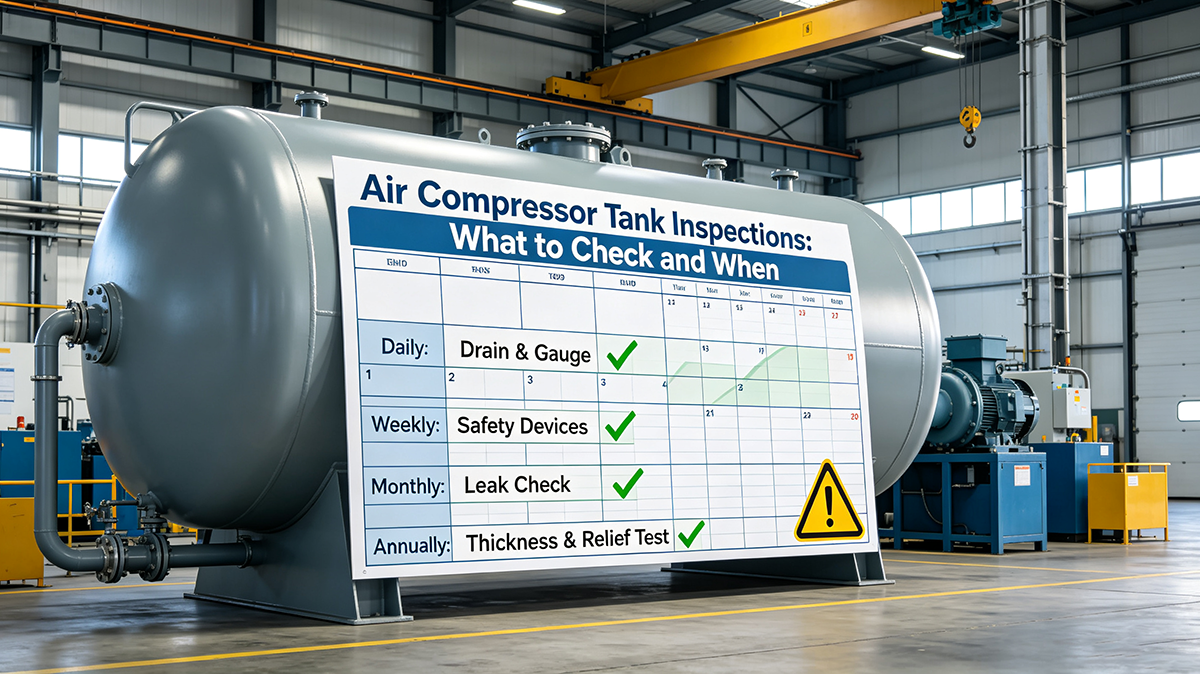
Daily/Weekly (Operator Level)
| Check | What to Look For |
|---|---|
| Condensate drain | Verify automatic drains cycle. Manually drain if no auto drain. Water should discharge, not just air. |
| Exterior visual | Rust spots, paint bubbling, damp patches at the base. |
| Pressure gauge | Reading should match system pressure. A stuck gauge hides real conditions. |
| Unusual noises | Whistling, rattling, or ringing during pressurization can indicate leak paths. |
A critical note on drains: A stuck automatic drain is worse than no drain at all—it creates a false sense of security while water accumulates. Verify drain operation by listening during cycles and checking for water discharge.
Monthly (Maintenance Level)
| Check | What to Do |
|---|---|
| Safety relief valve | Test according to site procedure. Replace if it sticks, chatters, or fails to reseat. |
| Drain valve internals | Inspect seals, screens, and discharge tubing. Clean or replace as needed. |
| Mounts and supports | Verify anchor bolts and saddles are secure. Look for fretting or movement. |
| Gauges and transmitters | Compare against a reference instrument. Replace drifting or stuck devices. |
Annual (Professional Level)
Internal visual inspection is the most important annual task—and the one most often skipped because it requires confined space entry and shutdown time.
If the tank has a safe manway and procedures permit entry:
- Check for scale, rust flakes, and pitting on interior surfaces
- Pay particular attention to the bottom where water accumulates
- Inspect weld seams for cracking or corrosion
- Photograph findings and log areas of concern
Ultrasonic thickness testing provides quantitative data that visual inspection alone cannot. An inspector measures remaining wall thickness at representative locations—shell, heads, and nozzles. Compare readings against the minimum allowable thickness specified by the original design code.
When thickness margins are inadequate, the tank is no longer safe for its rated pressure. Options: derate, repair, or replace.
The two-year benchmark: Under ASME standards for unfired pressure vessels, the interval between visual inspections should not exceed two years. In corrosive environments, high-humidity conditions, or tanks with a history of condensate issues, annual inspection is prudent.
Decision Criteria: Repair, Replace, or Continue
After inspection, the decision comes down to three questions:
1. How much wall thickness remains?
If ultrasonic readings show thickness above the minimum allowable, and corrosion is localized (isolated pits rather than widespread thinning), the tank may continue in service with increased inspection frequency.
If readings are at or below the minimum allowable, the tank cannot legally or safely continue at its rated pressure. Options: derate, repair, or replace.
2. Is the corrosion widespread or localized?
Localized pitting may be manageable if it does not compromise structural integrity. Widespread thinning across large areas of the shell is a different situation—it indicates the entire vessel is reaching end of life.
3. What is the cost comparison?
A general rule: if repair costs exceed 50% of replacement cost, replacement is usually the better decision. A repaired tank may still have unknown corrosion elsewhere—repairing one area does not restore the integrity of the entire vessel.
Warning signs that favor replacement:
- Corrosion is widespread across multiple areas
- Wall thickness is at or below minimum allowable in multiple locations
- The tank is beyond its expected design life (typically 15–20 years)
- The nameplate is missing or illegible
FAQ
Q1: How often should I inspect my air compressor tank?
Minimum: annual internal inspection if the tank has a manway and conditions permit. Visual external checks should be daily to weekly, depending on usage. In corrosive or high-humidity environments, inspect more frequently.
Q2: Does OSHA require hydrostatic testing of air receiver tanks?
No. OSHA’s air receivers standard (29 CFR 1910.169) does not require periodic hydrostatic retesting. However, this does not eliminate the need for internal inspection and thickness measurement as part of a safe maintenance program.
Q3: What is the ASME “U” stamp and why does it matter?
The “U” stamp on a tank nameplate certifies that the vessel was designed, constructed, inspected, and tested in accordance with ASME Boiler and Pressure Vessel Code Section VIII. It is evidence of compliance and a critical record for inspectors and insurers.
Q4: How do I know if my tank needs to be replaced?
If ultrasonic thickness testing shows wall thickness at or below the minimum allowable, or if corrosion is widespread across the shell and heads, replacement is the prudent decision. Localized pitting may be manageable with increased monitoring.
Q5: What happens if a tank fails?
A pressure vessel rupture releases stored energy suddenly. At typical industrial pressures, this can cause catastrophic injury or death. Documented failure assessments show that tanks with undetected weld defects can operate for years at risk levels that would be unacceptable if known.
Q6: Can I repair a corroded tank instead of replacing it?
Repairs must be performed in accordance with the applicable code (ASME BPVC or National Board Inspection Code). However, repairing one area does not address corrosion elsewhere. If repair costs exceed 50% of replacement cost, replacement is usually more economical.