
Compressed air is often called the “fourth utility” in industrial settings. But unlike electricity or water, compressed air leaving the compressor is hot, wet, and often contaminated with oil carryover. Without proper treatment, that moisture condenses in piping, corrodes tools, and ruins product quality.
An industrial air dryer solves this problem. This guide explains where the dryer fits in your compressed air system, why it is essential, and what to consider when selecting one.
Part One: What Does an Air System Look Like—and Why You Need a Dryer?
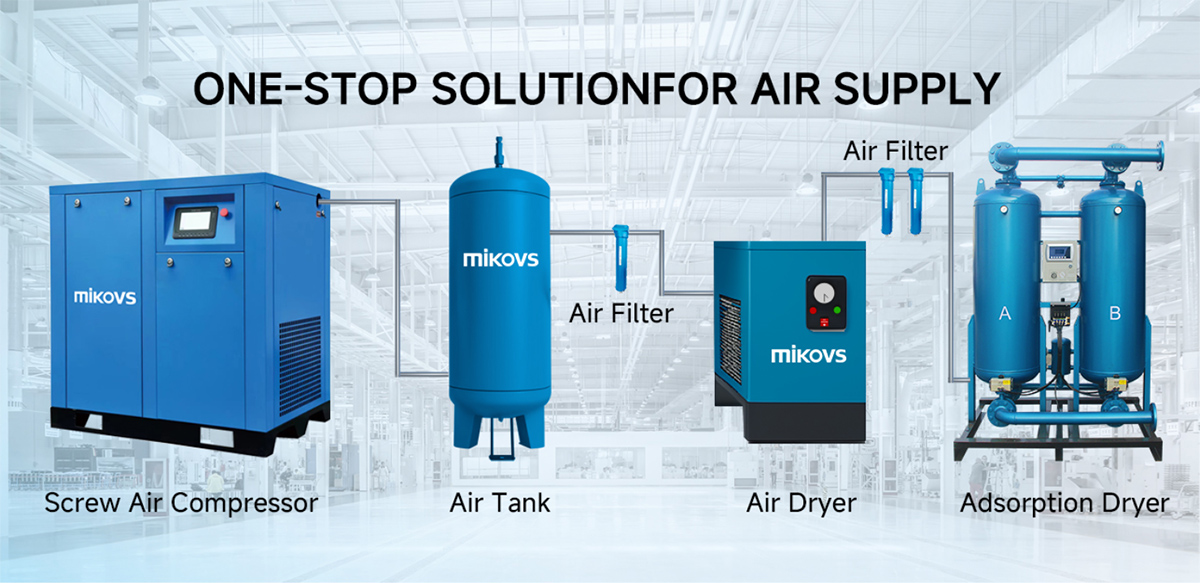
A complete compressed air system is more than just a compressor. It is a series of components working together to deliver clean, dry air at the required pressure and quality:
Compressor → Aftercooler → Receiver Tank → Air Dryer → Filters → Point of Use
Each component serves a specific purpose:
- Compressor: Produces compressed air, but the air leaving it is hot and saturated with moisture.
- Aftercooler: Cools the air, causing some water vapor to condense. However, it alone cannot achieve the low dew points required for most industrial applications.
- Receiver Tank: Stores air, smooths pressure fluctuations, and allows additional cooling and condensate drop-out.
- Air Dryer: The critical component that removes moisture vapor, lowering the pressure dew point (PDP) to a level that prevents condensation downstream.
- Filters: Remove particles, oil aerosols, and oil vapor that the dryer does not capture.
Why the dryer matters: When hot compressed air cools in distribution piping, water vapor condenses into liquid. This water causes:
- Corrosion of steel pipes and pneumatic components
- Tool failure—moisture washes away lubricants and causes rust
- Product contamination—water droplets ruin food, electronics, and paint finishes
- Freezing—in cold environments, condensate blocks air lines
A properly sized air dryer removes that moisture before it becomes a problem.
Part Two: What to Consider When Choosing an Air Dryer
1. Required Pressure Dew Point (PDP)
The pressure dew point is the temperature at which water vapor begins to condense at system pressure. This is the single most important selection criterion.
The rule: Specify a PDP at least 5–10°C below the lowest temperature your compressed air will encounter in the distribution system.
| If your piping… | Required PDP | Recommended Dryer Type |
|---|---|---|
| Stays indoors, above +10°C | +3°C to +10°C | Refrigerated dryer |
| Runs through unheated areas, or ambient drops below +3°C | -20°C to -40°C | Desiccant dryer |
| Requires ISO 8573-1 Class 1 (instrument air) | ≤ -40°C | Desiccant dryer |
Refrigerated dryers cool air to approximately +3°C, condensing water vapor for removal. They are the standard choice for general manufacturing, packaging, and service air—roughly 80% of industrial applications.
Desiccant dryers use adsorption to achieve dew points as low as -40°C to -70°C. They are required for food, pharmaceutical, electronics, and any application where air is exposed to freezing temperatures.
2. Flow Capacity
The dryer must handle the maximum flow rate (CFM or m³/min) of your compressor. Undersizing causes excessive pressure drop and moisture carryover.
Rule of thumb: Select a dryer rated for at least 1.2 times your compressor’s actual free air delivery to account for pressure drop and future growth.
3. Inlet Air Temperature
Refrigerated dryers are sensitive to inlet temperature. Most are rated for ambient temperatures up to 38–50°C and inlet temperatures up to 85°C. If your compressor discharges hotter air, you need an aftercooler upstream or a dryer rated for higher inlet temperatures.
4. Pressure Drop
Every component in the air treatment chain adds pressure drop. A well-designed system keeps total pressure drop below 10% of compressor discharge pressure.
Dryers with lower pressure drop reduce energy consumption—every 1 bar reduction in system pressure saves approximately 7% energy.
5. Operating Cost and Maintenance
Refrigerated dryers have low maintenance: primarily cleaning condenser coils and checking drains. Desiccant dryers require desiccant media replacement every 3–5 years and consume 15–20% of airflow for regeneration (heatless designs).
MIKOVS Air Dryer Solutions
For industrial operations requiring reliable moisture removal, MIKOVS refrigerated air dryers offer a practical solution.
MIKOVS refrigerated air dryers are designed with:
- Working pressure: ≤ 13 bar
- Maximum inlet temperature: 85°C
- Maximum ambient temperature: 50°C
- Minimum ambient temperature: 5°C
- Cooling method: Air-cooled
- Plug-and-play installation for easy integration into existing systems
These dryers provide a reliable, cost-effective, and simple solution to avoid condensation and corrosion in your compressed air system, reducing downtime and operating costs.
a professional compressed air solution provide and custom air compressor supplier with more than 15 years ‘experience and with a mission to build a compressor brand that combines quality, affordability, and serviceability—making reliable compressed air treatment accessible to industrial users worldwide.
Learn more about MIKOVS industrial air dryers: Visit www.mikovsair.com or contact our team for a selection consultation tailored to your compressed air system.
Quick Selection Checklist
| Decision Point | Key Question |
|---|---|
| PDP requirement | What is the lowest temperature the air will encounter? |
| Flow capacity | What is the compressor’s maximum FAD? |
| Inlet temperature | What is the compressor’s discharge temperature? |
| Pressure drop | Is total system drop below 10% of discharge pressure? |
| Maintenance capacity | Refrigerated (low) or desiccant (moderate)? |
| Brand support | Is the manufacturer reachable for parts and service? |
FAQ
Q1: Do I really need an air dryer, or can I just use a filter?
A filter removes particles and liquid droplets. A dryer removes water vapor—moisture in gaseous form that will condense later in your piping. Filters cannot achieve this. Both are necessary components of a complete air treatment system.
Q2: What is the difference between a refrigerated and desiccant dryer?
Refrigerated dryers cool air to condense moisture, achieving +3°C PDP. Desiccant dryers use adsorption to achieve -40°C or lower. Refrigerated is sufficient for most general applications; desiccant is required for food, pharma, electronics, or freezing environments.
Q3: How do I know what dew point I need?
The rule is: PDP should be at least 5–10°C below the lowest temperature your air will encounter in the distribution system. If piping runs outdoors in winter at -5°C, you need a PDP below -10°C—requiring a desiccant dryer.
Q4: Where should the dryer be installed in the system?
The correct sequence is: Compressor → Aftercooler → Receiver Tank → Air Dryer → Filters. Placing the dryer after the receiver allows the tank to cool the air and drop out bulk condensate first, reducing the dryer’s load.
Q5: How do I maintain a refrigerated air dryer?
Primary maintenance tasks: clean condenser coils (most common failure cause), test automatic drain operation daily, and replace inlet filters as scheduled. Blocked drains are a common cause of moisture carryover.