
Sandblasting is one of the most air-hungry pneumatic applications in any workshop. Unlike a nail gun or impact wrench that draws air in short bursts, a sandblaster consumes air continuously at high volume. An undersized compressor does not just slow the job down—it produces weak blasting, uneven surface preparation, and wasted abrasive.
The good news is that sizing a compressor for sandblasting follows a clear logic. It starts with the nozzle, not the compressor. Once you know the nozzle size and the pressure you need at the nozzle, the CFM requirement follows directly.
This guide covers how to calculate that requirement, how to add the right margin, and what compressor type fits different scales of blasting work.
Step 1: Start with Nozzle Size, Not Compressor Specs
The nozzle is the point where compressed air does its work. Its diameter determines how much air must flow through the system to maintain blasting pressure.
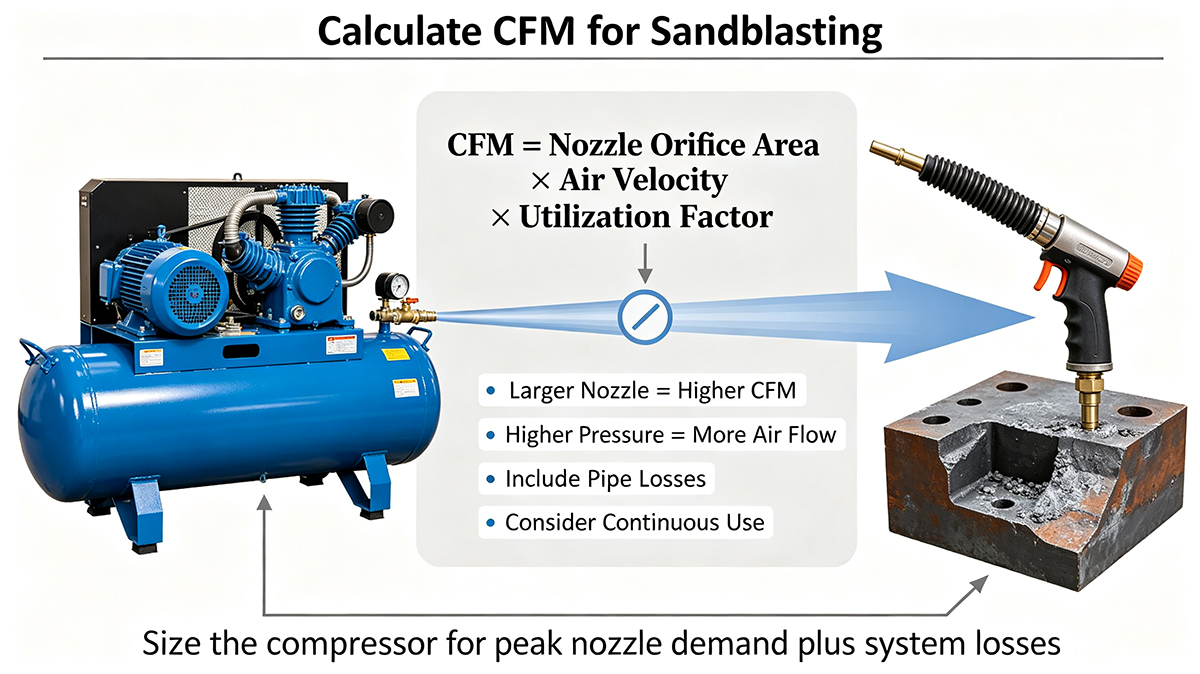
The relationship is direct: larger nozzle = more CFM required. A 3 mm nozzle may need around 10–28 CFM, while an 8 mm nozzle can require 78–187 CFM depending on pressure . Moving from a small nozzle to a large one does not increase air demand by a small amount—it multiplies it.
Why nozzle wear matters for sizing: As abrasive passes through the nozzle, it gradually enlarges the opening. A nozzle that starts at 6 mm may reach 7 mm or more after hours of use. The compressor that was “just right” when the nozzle was new becomes undersized as the nozzle wears . This is one reason sizing should include a margin above the baseline requirement.
Reference Table: Nozzle Size to Airflow Requirement
| Nozzle Size | Minimum Airflow (CFM) | Typical Pressure (bar) | Typical Application |
|---|---|---|---|
| 3 mm | 10–28 | 5.5–7 | Light blasting, spot cleaning, small parts |
| 5 mm | 25–64 | 6–7 | Small to medium surfaces, general maintenance |
| 6 mm | 46–110 | 6–8 | Medium-scale jobs, structural steel prep |
| 8 mm | 78–187 | 7–8.5 | Heavy-duty blasting, shipyards, foundries |
| 10 mm | 106–265 | 7–9 | Industrial-scale blasting, pipelines |
Source: Atlas Copco nozzle-to-airflow reference data
Step 2: Determine the Pressure at the Nozzle
Sandblasting is most effective when the pressure at the nozzle stays in the 90–100 PSI range for most applications . Lower pressure reduces cutting power; higher pressure increases abrasive velocity but also wear on the nozzle and hose.
The critical distinction: The pressure reading at the compressor is not the pressure at the nozzle. Air loses pressure as it travels through hoses, fittings, and the blast pot. A compressor set to 100 PSI may deliver only 85–90 PSI at the nozzle after losses.
How to account for pressure drop:
- Hose length: Approximately 2 PSI drop per 50 feet of blast hose .
- Blast pot: Roughly 0.75 PSI loss across the pot .
- Fittings and couplers: Additional losses depending on restriction.
Practical implication: If you need 100 PSI at the nozzle and your hose run is 100 feet, the compressor must supply roughly 105 PSI at its outlet to compensate for losses .
Step 3: Add a Safety Margin
Do not size the compressor to match the nozzle requirement exactly. Two factors make a margin necessary:
- Nozzle wear increases air demand over time, as described above.
- System losses (hose pressure drop, filter restriction) mean the compressor must work harder than the nozzle alone suggests.
Industry recommendation: Add 20–30% to the baseline CFM requirement . For a sandblaster requiring 100 CFM at the nozzle, select a compressor rated for 120–130 CFM continuous output.
A note on “rated” vs “actual” output: Compressor specifications often list a maximum CFM that is achievable only under ideal conditions. The Free Air Delivery (FAD) rating at your actual operating pressure is what matters. A compressor rated “130 CFM” at 100 PSI may deliver less at 125 PSI. Always verify the CFM rating at the pressure you will actually use .
Step 4: Match Compressor Type to the Scale of Work
The type of compressor that makes sense depends on whether the blasting is intermittent or continuous.
Small-Scale or Intermittent Blasting (Workshops, Auto Restoration)
Piston compressors are suitable for light blasting with small nozzles (3–6 mm) where the work is intermittent . They are affordable and durable, but limited in duty cycle. A typical shop compressor with a 60–80 gallon tank can support short blasting sessions, but will struggle with continuous production.
What to watch for: A 6-gallon compressor cannot run a sandblaster effectively . Even a 20-gallon unit will struggle with anything beyond a very small nozzle. For any serious sandblasting, a two-stage piston compressor with a large tank and high CFM rating is the minimum.
Continuous or Industrial Blasting (Shipyards, Large Fabrication)
Rotary screw or diesel-powered compressors are required for continuous operation and larger nozzles (8–13 mm) . These machines are designed for 100% duty cycle and deliver the high airflow that large nozzles demand.
Portability matters: For field work or job sites without reliable power, a tow-behind diesel compressor is the standard choice. For fixed workshop installations, an electric rotary screw compressor provides the same output with lower noise and no fuel handling.
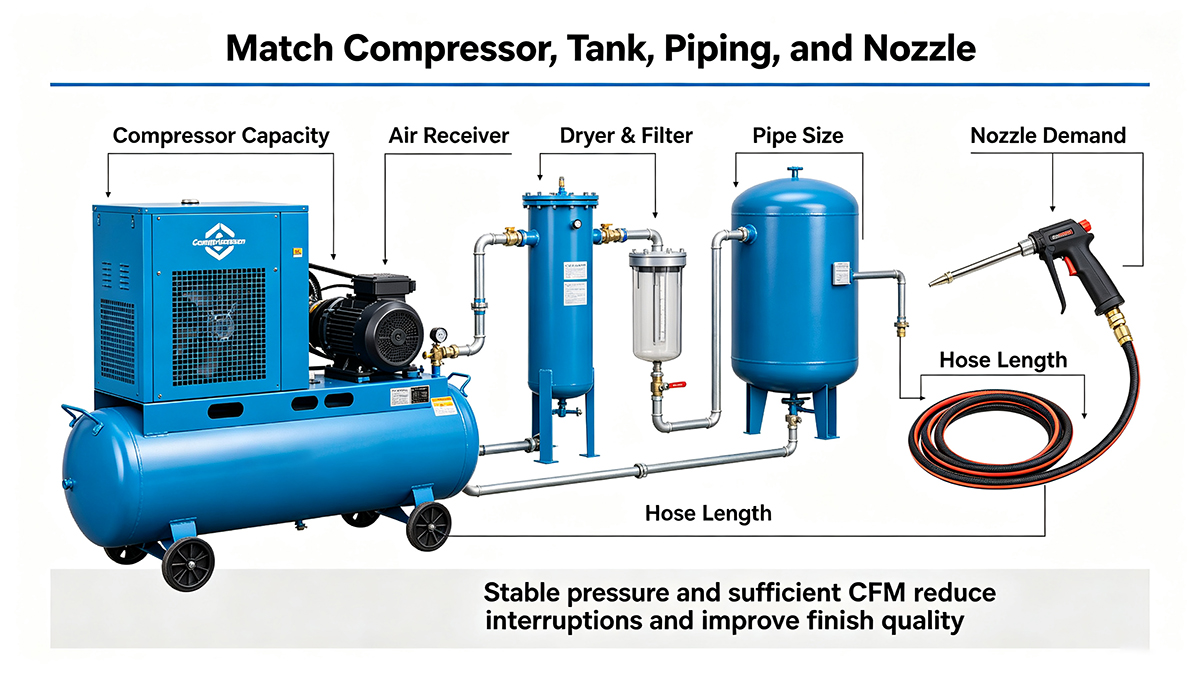
A Worked Example
Scenario: A workshop wants to run a sandblasting cabinet with a 6 mm nozzle, targeting 90 PSI at the nozzle. The hose run is 50 feet.
Step 1 — Baseline CFM: A 6 mm nozzle at 90 PSI requires roughly 90–100 CFM (from reference tables).
Step 2 — Pressure compensation: With 50 feet of hose, pressure drop is approximately 2 PSI. Blast pot loss is ~0.75 PSI. Total drop ≈ 3 PSI. Compressor supply pressure should be 93–95 PSI to maintain 90 PSI at the nozzle.
Step 3 — Safety margin: Add 25% to the baseline CFM. 100 CFM × 1.25 = 125 CFM.
Step 4 — Selection: The compressor should deliver at least 125 CFM at 95 PSI continuously. For a workshop with intermittent use, a large two-stage piston compressor is a candidate. For more frequent or longer blasting sessions, a small rotary screw compressor provides the duty cycle reliability.
FAQ
Q1: What size compressor do I need for a small sandblasting cabinet?
For a small cabinet with a 3–5 mm nozzle, you typically need 10–40 CFM depending on nozzle size and pressure . A large shop compressor with a 60–80 gallon tank is the starting point. Small portable compressors (6-gallon) cannot sustain sandblasting.
Q2: Can I use a 6-gallon compressor for sandblasting?
No. A 6-gallon compressor cannot deliver the high CFM that sandblasters require. You may get a few seconds of blasting with a very small nozzle, but the compressor will lose pressure immediately and cannot keep up .
Q3: Why is CFM more important than PSI for sandblasting?
Sandblasting consumes air continuously. If the compressor cannot deliver enough volume (CFM), pressure at the nozzle drops and blasting becomes ineffective—regardless of how high the compressor’s maximum PSI rating is. Pressure is necessary, but airflow sustains the process .
Q4: How much margin should I add to the CFM requirement?
Add 20–30% above the baseline nozzle requirement . This accounts for nozzle wear over time and pressure losses in the hose and blast pot.
Q5: Do I need a rotary screw compressor for sandblasting?
Only if the work is continuous. For intermittent blasting in a workshop, a large piston compressor can suffice. For shipyards, large fabrication, or any operation running the blaster for extended periods, a rotary screw or diesel compressor is necessary for 100% duty cycle reliability .