
The question “how long does an air compressor last” seems simple. The honest answer is: it depends—but not in a vague, unhelpful way. There are documented ranges by compressor type, and there are specific factors that push a machine toward the top or bottom of that range.
A compressor that runs in a clean, climate-controlled room with disciplined maintenance can outlast its rated expectation by years. The same model in a dusty foundry, running beyond its duty cycle with neglected filters, may fail in half the time. This article covers the numbers, the variables, and the maintenance practices that separate a 6-year machine from a 20-year one.
Factors That Determine Air Compressor Lifespan
Compressor Type and Duty Cycle
The single most important factor is the duty cycle the machine was designed for and whether actual operation matches it.
A compressor rated for 100% continuous duty is built with heavier bearings, larger cooling capacity, and more robust components than a unit rated for 50–60% duty cycle. Running a light-duty piston compressor continuously is the fastest way to destroy it—overheating degrades oil, warps components, and accelerates bearing failure .
Conversely, an oversized rotary screw compressor that short-cycles (starts and stops frequently because demand never reaches its capacity) suffers a different problem: it never reaches stable operating temperature, moisture accumulates in the lubricant, and frequent starts stress motor windings and couplings .
Operating Environment
The room the compressor lives in matters as much as the compressor itself.
Heat is the enemy. A compressor in a poorly ventilated room runs hotter, oxidizes oil faster, and wears bearings prematurely. Dust clogs filters and coats cooler fins, reducing cooling efficiency and forcing the machine to work harder. Moisture promotes corrosion and oil emulsion .
A clean, dry, well-ventilated location with ambient temperatures in a moderate range (roughly 50–85°F / 10–30°C) can add years to a compressor’s service life .
This is the factor the operator controls. A compressor that receives scheduled oil changes, filter replacements, and condensate drainage will consistently outlast one that is run until something breaks. The difference is not subtle—it is often the difference between reaching the top of the lifespan range and falling short of the bottom .
Sizing Accuracy
An undersized compressor runs continuously trying to meet demand, accelerating wear. An oversized compressor cycles excessively, never stabilizing temperature, and wastes energy. A correctly sized compressor operates in its optimal range—delivering the required air without unnecessary strain .
Average Lifespan by Compressor Type
Lifespan is best measured in operating hours, not calendar years, because usage intensity varies enormously. A compressor running one shift per day accumulates hours at one-third the rate of a 24/7 operation. The following ranges reflect typical industrial and commercial use.
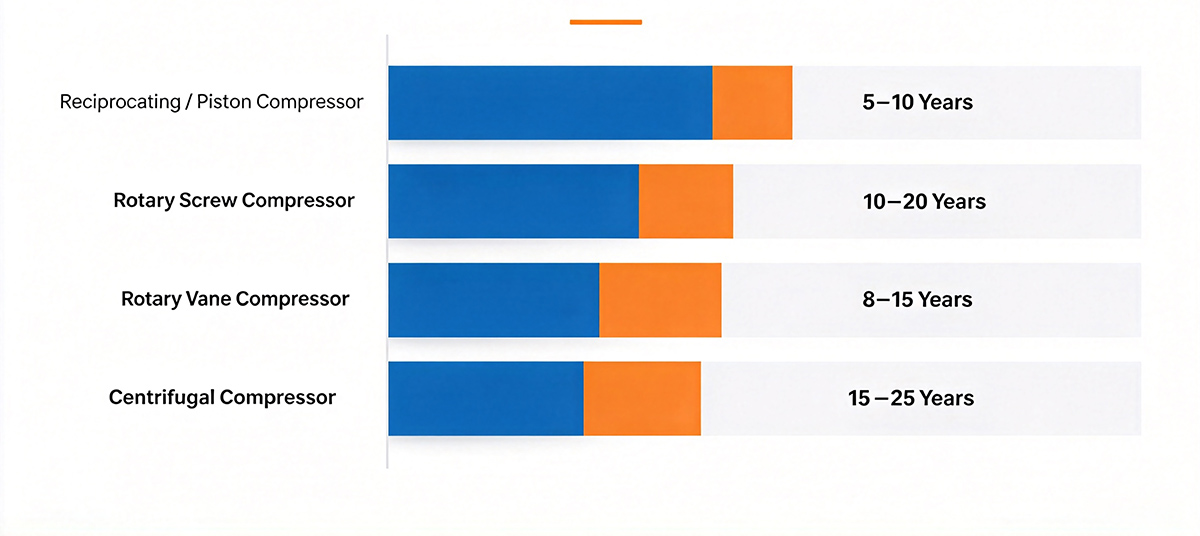
Important context: These are ranges, not guarantees. Industry observations suggest that many facilities replace compressors around the 10-year mark regardless of type—often because maintenance costs rise, efficiency declines, or production needs change . A well-maintained oil-flooded rotary screw can exceed 100,000 hours; a neglected piston compressor may not reach 30,000.
What the Ranges Mean in Practice
A piston compressor in a small auto shop running 2,000 hours per year might last 15–20 calendar years. The same compressor in a production environment running 6,000 hours per year might reach only 8 years. The hours are the same; the calendar time is not.
A rotary screw compressor in a 24/7 manufacturing plant accumulates hours quickly. At 8,000 hours per year, a 100,000-hour machine reaches end of life in roughly 12–13 years. At 4,000 hours per year, the same machine could last 25 years.
The Role of Regular Maintenance
Maintenance is not just about preventing breakdowns. It directly determines where a compressor falls within its lifespan range.
What Maintenance Actually Protects
Oil quality is the lifeline of oil-lubricated compressors. Oil cools, lubricates, and seals. When oil degrades—through heat, moisture, or extended service—it stops protecting the machine. Varnish and sludge form, bearings wear, and the airend loses efficiency. Regular oil changes and oil analysis are the most direct way to extend life .
Filters protect the compressor from ingesting contaminants. A clogged air filter restricts airflow, forcing the compressor to work harder and run hotter. A clogged oil filter starves bearings of lubrication. Both accelerate wear in ways that are invisible until failure occurs .
Cooling system health determines operating temperature. Dust-clogged coolers and blocked ventilation cause the compressor to run hot, which degrades oil and stresses every component. Cleaning coolers and verifying ventilation is a simple task with outsized impact on lifespan .
Condensate management prevents water from accumulating in the oil and tank. Water causes corrosion, promotes emulsion, and reduces lubricating effectiveness. Daily draining—and verifying that automatic drains actually work—is a basic but critical habit .
The Maintenance Schedule That Extends Life
Following the manufacturer’s schedule—adjusted shorter for harsh conditions—is the single most reliable way to reach the upper end of a compressor’s lifespan range.
FAQ
Q1: How long do air compressors last in years?
It depends on type and usage. Reciprocating compressors typically last 6–10 years, oil-free rotary screw 8–15 years, and oil-flooded rotary screw 15–20+ years under normal industrial use . These ranges assume proper maintenance and reasonable operating conditions.
Q2: Is lifespan measured in hours or years?
Both, but hours are more accurate. A compressor rated for 50,000 hours will last roughly 6 years at 8,000 hours/year, but 12+ years at 4,000 hours/year. Always consider your actual annual operating hours when estimating remaining life.
Q3: What is the biggest factor that shortens compressor life?
Heat and poor maintenance are the two dominant factors. Running a compressor beyond its duty cycle, in a poorly ventilated space, with neglected oil and filters, accelerates wear dramatically. An oversized compressor that short-cycles is also at risk because it never reaches stable operating temperature .
Q4: Can I extend the life of my compressor?
Yes. The most effective actions: follow the maintenance schedule, keep the compressor room cool and clean, drain condensate daily, and fix leaks promptly. A well-maintained compressor routinely exceeds the typical lifespan range for its type .
Q5: When should I replace instead of repair?
Consider replacement when repairs approach 50% of the cost of a new unit, when breakdowns become frequent, or when energy consumption has risen noticeably without increased production. A compressor approaching the end of its expected lifespan range is also a candidate for planned replacement rather than emergency failure .