
Every rotary screw compressor generates heat. Compressing air from atmospheric pressure to 7 bar produces thermal energy that must be removed continuously—if it is not, the oil degrades, bearings wear, and the machine eventually seizes.
The industry uses two methods to remove that heat: air cooling and water cooling. A third term, “oil cooling,” often appears in sales literature, but it describes something different: the oil’s role as a heat carrier inside the compressor, not a separate cooling system. Both air-cooled and water-cooled compressors rely on oil to move heat from the compression chamber to the cooler—the question is what happens after that.
This guide clarifies the actual difference between the two cooling systems, how each works, and how to choose based on your facility’s conditions.
Clearing Up the “Oil-Cooled” Confusion
Before comparing air and water cooling, it is worth understanding what “oil cooling” actually means in a screw compressor.
In an oil-injected screw compressor, oil is injected into the compression chamber. It performs three functions: lubricating the rotors, sealing the gaps between them, and absorbing the heat of compression. The hot oil then flows to a cooler, where it is cooled before returning to the chamber.
That cooler is where air-cooled and water-cooled designs diverge:
- An air-cooled compressor uses a fan to blow ambient air across the oil cooler (and the compressed air aftercooler, often combined into one unit).
- A water-cooled compressor uses a shell-and-tube heat exchanger, where cooling water absorbs the heat from the oil.
So “oil-cooled” is not a third category. It describes the internal mechanism that both types share. The real choice is how the heat is ultimately rejected: to air or to water.
How Air-Cooled Screw Compressors Work
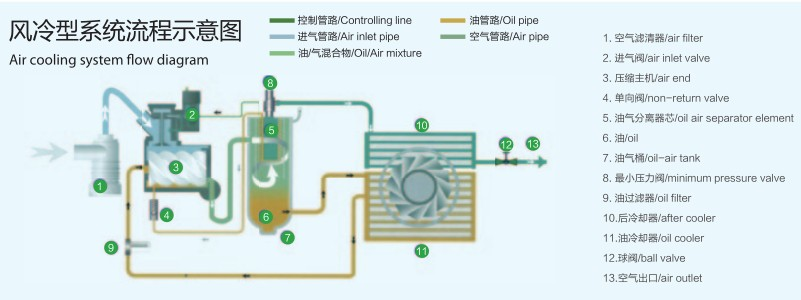
An air-cooled compressor uses a plate-fin heat exchanger (typically aluminum) with an integrated fan. Hot oil and hot compressed air flow through separate passages inside the cooler, while the fan forces ambient air across the fins. The heat transfers to the air stream and is expelled into the compressor room or ducted outside.
Key characteristics:
| Factor | Detail |
|---|---|
| Cooling medium | Ambient air |
| Dependence on environment | High—cooling performance drops as ambient temperature rises |
| Installation | Simple—no water piping, no cooling tower |
| Ventilation requirement | Critical—the room must exhaust the heat, or it recirculates |
| Noise | Higher—the cooling fan adds to compressor noise |
| Water availability | Not required |
The most common failure mode: inadequate ventilation. A compressor in a closed room draws in its own heated exhaust, causing temperatures to climb until the unit trips on high-temperature protection. Air-cooled units are most reliable when installed with proper ducting or a well-designed ventilation system.
How Water-Cooled Screw Compressors Work
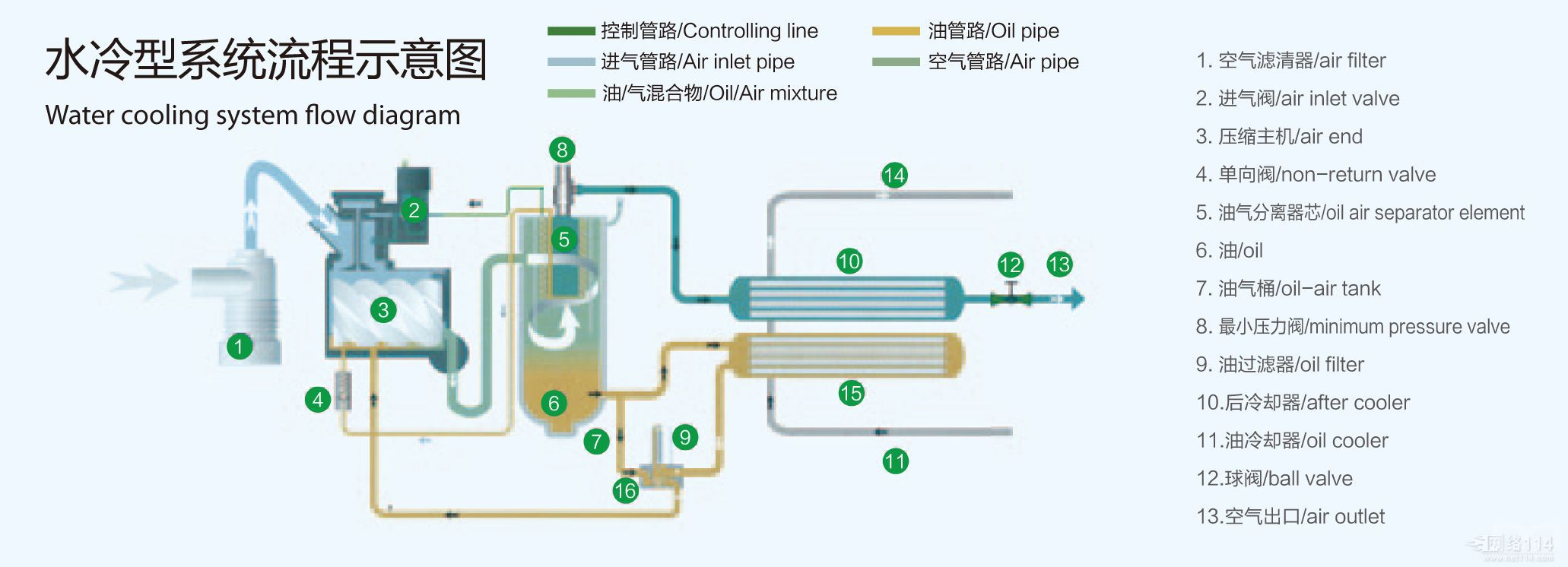
A water-cooled compressor uses a shell-and-tube heat exchanger. Hot oil flows through the shell side while cooling water flows through the tubes (or vice versa). The water absorbs the heat and carries it away—typically to a cooling tower, dry cooler, or once-through discharge system.
Key characteristics:
| Factor | Detail |
|---|---|
| Cooling medium | Water from an external source |
| Dependence on environment | Low—cooling performance is stable regardless of ambient temperature |
| Installation | Complex—requires water piping, pumps, and a cooling system |
| Water quality requirement | Critical—scale and corrosion degrade heat transfer |
| Noise | Lower—no large cooling fan required |
| Water availability | Essential—and water must be treated |
The most common failure mode: poor water quality. Scale buildup in the heat exchanger reduces cooling capacity and eventually causes overheating. Water treatment (filtration, softening, chemical dosing) is not optional—it is part of the system’s operating cost.
Direct Comparison
| Factor | Air-Cooled | Water-Cooled |
|---|---|---|
| Cooling stability | Depends on ambient temperature | Stable regardless of ambient |
| Installation cost | Lower | Higher (piping, pump, cooling tower) |
| Operating cost | Fan power + ventilation | Water, treatment, pumping, tower operation |
| Maintenance | Clean cooler fins, verify ventilation | Water treatment, descaling, pump maintenance |
| Footprint | Larger radiator, but no auxiliary equipment | Compact compressor, but requires cooling system space |
| Noise | Higher (fan) | Lower |
| Best for | Moderate climates, adequate ventilation | Hot/dirty environments, large units, confined spaces |
Which Should You Choose?
Choose Air-Cooled When:
- Ambient temperatures are moderate and the room can be ventilated or ducted
- Water is unavailable, expensive, or requires treatment you don’t want to manage
- The compressor is below roughly 100–125 HP (radiators become impractically large at higher power)
- Installation simplicity and lower upfront cost are priorities
Choose Water-Cooled When:
- The compressor room is confined or poorly ventilated
- Ambient temperatures are high or the environment is dusty/dirty (water cooling is unaffected by air conditions)
- The compressor is large (above 125 HP)
- An existing cooling tower has spare capacity
- You need stable cooling performance independent of seasonal temperature swings
A Practical Note on Maintenance
Air-cooled units fail most often because of neglected ventilation and dirty coolers. Cleaning the cooler fins regularly and ensuring the room exhausts hot air are the two tasks that determine reliability.
Water-cooled units fail most often because of water quality. Scale in the heat exchanger is the leading cause of overheating. If you choose water-cooled, budget for water treatment and periodic descaling from the start—it is not a cost you can defer.
Frequently Asked Questions
Q1: Is “oil-cooled” a separate type of screw compressor?
No. Oil cooling describes the internal mechanism: oil absorbs heat in the compression chamber and carries it to a cooler. Both air-cooled and water-cooled compressors use this mechanism—the difference is whether the oil’s heat is rejected to air or to water.
Q2: Can I install an air-cooled compressor in a small room?
Only with adequate ventilation. A small room without airflow will cause the compressor to overheat. You need an exhaust fan or ductwork to remove the heated air. If ventilation is impractical, water-cooled is the better choice.
Q3: Is water-cooled more efficient than air-cooled?
The compressor itself may run slightly more efficiently because water cooling maintains more stable temperatures. But the total system cost includes water, treatment, pumping, and cooling tower operation. For most small-to-medium applications, air-cooled is more cost-effective overall.
Q4: What water quality does a water-cooled compressor need?
Water must be treated to prevent scale and corrosion. Untreated water causes heat exchanger fouling, which reduces cooling capacity and eventually leads to overheating. Water treatment is a continuous operating cost, not a one-time setup.
Q5: Can I switch from air-cooled to water-cooled later?
No. The cooling system is integrated into the compressor design. Converting is not practical—it would require replacing the cooler and adding water connections. The decision must be made at purchase.