
Every air compressor generates heat during operation. Compressing air from atmospheric pressure to 7 bar produces significant thermal energy—and if that heat is not removed, the compressor will overheat, oil will degrade, and components will fail.
Two cooling methods dominate the industry: air-cooled and water-cooled. The choice between them is not about which is “better”—it depends on your facility, environment, and operating costs. Industry estimates suggest roughly 80% of rotary screw compressors are air-cooled, while water-cooled units become more common in larger machines above 125 HP .
This article explains how each system works, what each requires, and how to decide which fits your operation.
What Are Air-Cooled and Water-Cooled Compressors?
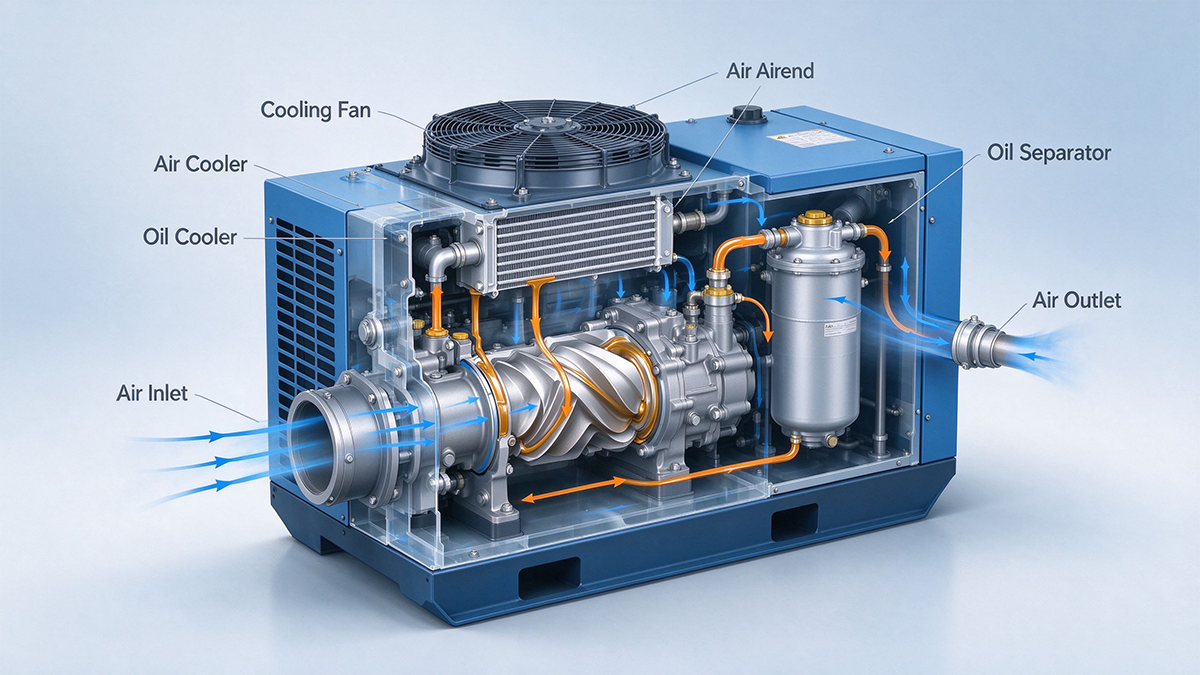
Air-cooled compressors use ambient air to remove heat. A fan draws air across a radiator (heat exchanger), and the heated air is expelled into the surrounding environment or ducted outside .
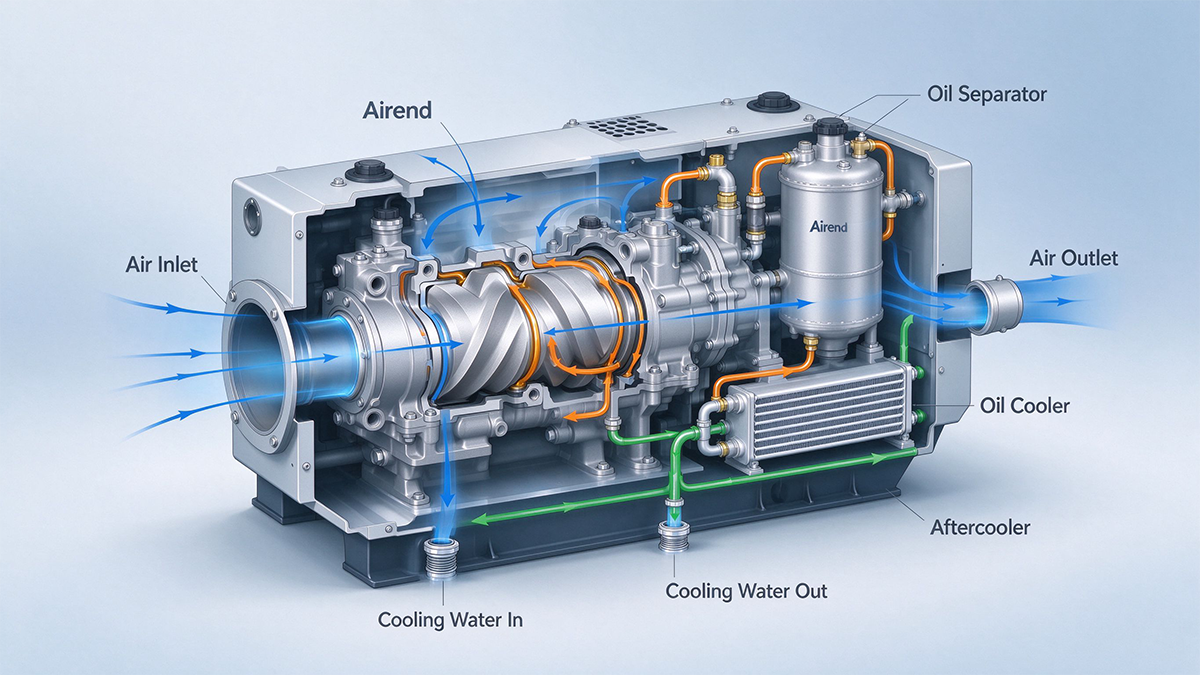
Water-cooled compressors use a liquid coolant—typically water, sometimes with glycol—from an external source. The coolant circulates through a heat exchanger (shell and tube or plate type), absorbs heat from the compressor and compressed air, and carries it away to a cooling tower, dry cooler, or drain .
The fundamental difference is where the heat goes: air-cooled units release it into the compressor room or outdoors; water-cooled units transfer it to a water system.
How They Work
Air-Cooled: Fan and Radiator
The compressor’s oil and compressed air pass through a radiator. A fan forces ambient air across the radiator fins, cooling the oil and air inside. The heated air is then exhausted—either into the room (which requires ventilation) or through ductwork to the outside .
Key limitation: Cooling effectiveness depends on ambient air temperature. On a hot day, the radiator cannot cool as effectively as on a cold day. This is why air-cooled compressors have ambient temperature limits—typically 40–50°C depending on the model .
Water-Cooled: Heat Exchanger and Coolant Loop
The compressor’s oil and air pass through a heat exchanger. Coolant flows through the other side, absorbing heat and carrying it away. The warmed coolant then goes to a cooling tower, dry cooler, or is discharged .
Key advantage: Water cooling is not affected by ambient air temperature. A water-cooled compressor can maintain consistent cooling performance even in a hot, dirty, or confined space where air-cooled units struggle .
Requirements for Each System
Air-Cooled Compressor Requirements
| Requirement | Detail |
|---|---|
| Ventilation | Adequate airflow to and from the compressor. Without proper ventilation, hot air recirculates and cooling fails |
| Space | Clearance around the unit for air intake and exhaust. Ducting may be needed to route hot air outside |
| Ambient temperature | Typically below 40–50°C. Higher ambient = reduced cooling capacity |
| Clean air | Dusty or dirty intake air clogs radiator fins and reduces efficiency |
The most common failure mode: improper ventilation. A compressor in a closed room with no exhaust will overheat, trip on high temperature, and eventually damage components .
Water-Cooled Compressor Requirements
The most common failure mode: poor water quality. Scale buildup in the heat exchanger reduces cooling capacity and eventually causes overheating .
Which Should You Choose?
Choose Air-Cooled When:
- You have adequate space and ventilation—or can install ductwork
- Ambient temperatures are moderate (below 40°C)
- Water is expensive, unavailable, or requires treatment
- The compressor is below ~100 HP—smaller units are almost exclusively air-cooled
- Installation simplicity matters—air-cooled units are “plug and play” with no water connections
Cost advantage: Air-cooled compressors typically have lower upfront and installation costs because they do not require plumbing, pumps, cooling towers, or water treatment .
Choose Water-Cooled When:
- The compressor room is confined or poorly ventilated—water-cooled units reject heat to water, not the room
- Ambient temperatures are high or the environment is dusty/dirty—water cooling is unaffected by air conditions
- The compressor is large (above 125–150 HP)—radiators become impractically large at high power
- You have an existing cooling tower with spare capacity—the incremental cost may be low
- You need maximum air purity—water-cooled systems eliminate the risk of ambient contaminants entering the cooling air stream
Operating cost consideration: Water-cooled compressors may be slightly more energy-efficient in the compression process, but the total cost includes water, treatment, pumping, and cooling tower maintenance. Once these are factored in, air-cooled is often more cost-effective for smaller operations .
A Decision Framework
| Your Situation | Recommended Choice |
|---|---|
| Small workshop, good ventilation, water not available | Air-cooled |
| Large plant, existing cooling tower, hot/dirty environment | Water-cooled |
| Confined compressor room, cannot duct hot air outside | Water-cooled |
| Budget-sensitive, installation simplicity priority | Air-cooled |
| Compressor above 150 HP | Water-cooled (or evaluate both) |
| Ambient consistently above 45°C | Water-cooled |
FAQ
Q1: Can I install an air-cooled compressor in a small room?
Only if you provide adequate ventilation. A small room without airflow will cause the compressor to overheat. You need either a large exhaust fan, ductwork to route hot air outside, or both. If ventilation is impractical, a water-cooled unit is the better choice.
Q2: Is water-cooled more efficient than air-cooled?
The compressor itself may be slightly more efficient because water cooling is more effective at maintaining optimal temperatures. However, the total system cost includes water, treatment, pumping, and cooling tower operation. For most small-to-medium applications, air-cooled is more cost-effective overall .
Q3: What water quality does a water-cooled compressor need?
Water must be treated to prevent scale and corrosion. Typical requirements: pH 6.8–8.0, low hardness, filtered to remove particles, and free of corrosive agents. Untreated water will cause heat exchanger fouling and cooling failure .
Q4: Can I switch from air-cooled to water-cooled later?
No. The cooling system is integrated into the compressor design. Converting is not practical—it would require replacing major components. The decision must be made at purchase.
Q5: Which type is more common?
Air-cooled compressors dominate the market, especially below 100 HP. Industry estimates suggest roughly 80% of rotary screw compressors are air-cooled. Water-cooled becomes more common in larger machines above 125 HP .